OFFER Get a free set of wall happiness tester cards! OFFER
Are Your Walls all Happy Walls?
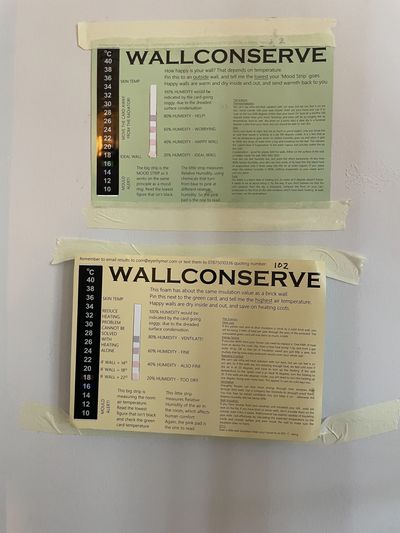
Free Offer! In the Name of Science!
These postcards each have a humidity and temperature test strip, can tell you a lot, and us a lot more. Click on the image, fill out the form and we will send them to you, free of charge. Then send us a photo taken on a coldish morning, and we will tell you if your wall is happy (most walls are) or if it we can make it happier.
The Science: Radiant Heat
We can’t see infra-red heat radiation with our eyes, but we can feel it on our skin. Stand outside with your eyes closed. Hold out your hand and use it to ‘look at’ the sun,5000 degrees hotter than your hand. Or ‘look at’ a bonfire 500 degrees hotter than your hand. Buildings and trees will be hard to ‘see’. But (even on a sunny day) you should be able to ‘see’ the stratosphere - a clear sky is fifty degrees colder than your hand.
The Science: Humidity
Your skin can feel humidity too, and if it's hot it sweats. Body heat is turned into the latent heat of evaporation, and (up to 100% Relative Humidity) the heat it floats away into the air in water vapour. With walls we use the more delicate word 'breathe' but evaporation from the surface, when it isn't raining or foggy, is what keeps them dry. All our solutions make sure the wall dries out more than it gets wet.
The Science: Dew
The tops of things that are ‘looking’ at thecold sky get a coating of cold air at night. The surface of roofs and windscreens, just as much as leaves of grass, find that Relative Humidity climb as the temperature falls. It gets to 100%, tiny drops of water form a fog and condense as dew. This releases the ‘Latent Heat of Evaporation’ in the water vapour and actually makes the air less cold. So dew (condensation) is good for plants, but BAD for walls. BAD on the surface of the wall, BAD hidden inside it.
The Science: Frost
Yes, there is a latent heat of melting too. So water at 0 degrees doesn’t freeze, it needs to be at about -2 degrees. If dew goes beyond this it turns into frost. Any frost inside your wall can do structural damage. That's why all our solutions to cold walls make sure this never happens.
By the way, if youwant proof that the cold radiation from the sky is important, compare the frost on your car’s windscreen to the frost on the side windows, which have been ‘looking’ at walls and trees, not the stratosphere.